Personal Finance
Why You Overspend When You're Tired (and What to Do About It)
After a short night the brain values rewards more and losses less. Overspending when tired is a measured shift, not a character flaw, and the fix is structural: move money decisions out of your tired hours.
Key takeaways: after a short night, the brain values rewards more and losses less; that is a measured shift in how you price a purchase, not a character flaw. The fix is structural, not motivational: move money decisions out of your tired hours, add friction to the late-night paths, and log sleep next to spending so the pattern becomes visible.
Most overspending advice assumes you are the same person at 8 a.m. and 11 p.m. You are not. The person who opens a shopping app at 11:40 p.m. after five hours of sleep is running on a different valuation system than the one who wrote the budget on Sunday morning. Understanding that difference is the fastest way to stop the pattern, because it tells you when to intervene instead of how hard to try.
What a bad night does to a money decision
In a 2011 study in the Journal of Neuroscience, Venkatraman and colleagues had healthy adults make risky monetary choices twice: once rested, once after a full night without sleep. Sleep-deprived, the same people shifted from avoiding losses to chasing gains. Brain imaging showed more activity in the region that values rewards and less in the region that registers risk. The shift was not explained by simple drowsiness; the valuation itself had moved.
A 2022 study in the Journal of Sleep Research with 47 young adults found the effect is real under partial sleep restriction too, not only total deprivation, though it plays out differently by sex and by whether a choice is framed as a gain or a loss. A related naturalistic study found that night-to-night variability in sleep predicted riskier choices better than average duration did. An irregular week is worse for your wallet than a consistently short one.
The effect reaches beyond the lab. A 2024 paper in Management Science showed that the mild sleep disruption around the spring daylight-saving change measurably degraded financial forecasts by non-professionals. A 2023 working paper on real loan applications found that insufficient sleep raised default risk, with applicants showing more heuristic, less deliberate processing.
Decision fatigue: what survived the replication debate
You have probably read that willpower is a battery that drains through the day. The strong version of that claim, "ego depletion", did not survive replication: a 2016 multi-lab effort across 23 sites found an effect close to zero. So do not build your money system on the idea that you have a fixed daily stock of self-control.
What did survive is narrower and more useful. Fatigue, low sleep and long stretches of small decisions reliably push people toward the default, the fast option and the immediate reward. Late-evening shopping is precisely that environment: the app remembers your card, the button says "buy now", and the reward arrives before the cost. You are not weaker at night; the environment is simply built for the tired version of you.
The pattern most people never see
Spending apps show you categories. Sleep apps show you hours. Neither shows you the sentence that matters: "I spend 60 percent more on the day after a night under six hours." That correlation is invisible until money and sleep sit on one timeline. When they do, it is usually obvious within two weeks, and it changes the question from "why do I keep overspending?" to "why did I sleep five hours on Tuesday?"
The same holds for skipped meals and late shifts. Hunger and fatigue are two of the most consistent triggers behind the convenience spending described in our guide on how to stop overspending, and neither one shows up in a bank statement.
Five fixes that work on the tired brain
1. Move money decisions to a fixed daytime slot
Anything above a small threshold (say, the cost of a dinner out) gets decided in a 10-minute slot the next morning. Not forbidden, just moved. Most late-night wants do not survive a night of sleep, which is the whole point of the 24-hour rule.
2. Add friction only on the night paths
Remove saved cards from the two apps you open in bed. Log out of one-click checkout. Keep the friction narrow: a budget that makes every purchase harder gets abandoned, but one that makes the 11 p.m. purchase slightly slower survives.
3. Protect sleep regularity before duration
The research points at variability, not just short nights. A fixed wake-up time seven days a week does more for your spending than an occasional long sleep-in, which also disturbs the following night.
4. Treat a short night as a spending day
On the morning after a bad night, expect the pull toward convenience and pre-decide lunch, dinner and transport. A tired brain that already has a plan does not need to choose, and choosing is where the money goes.
5. Review the week, not the purchase
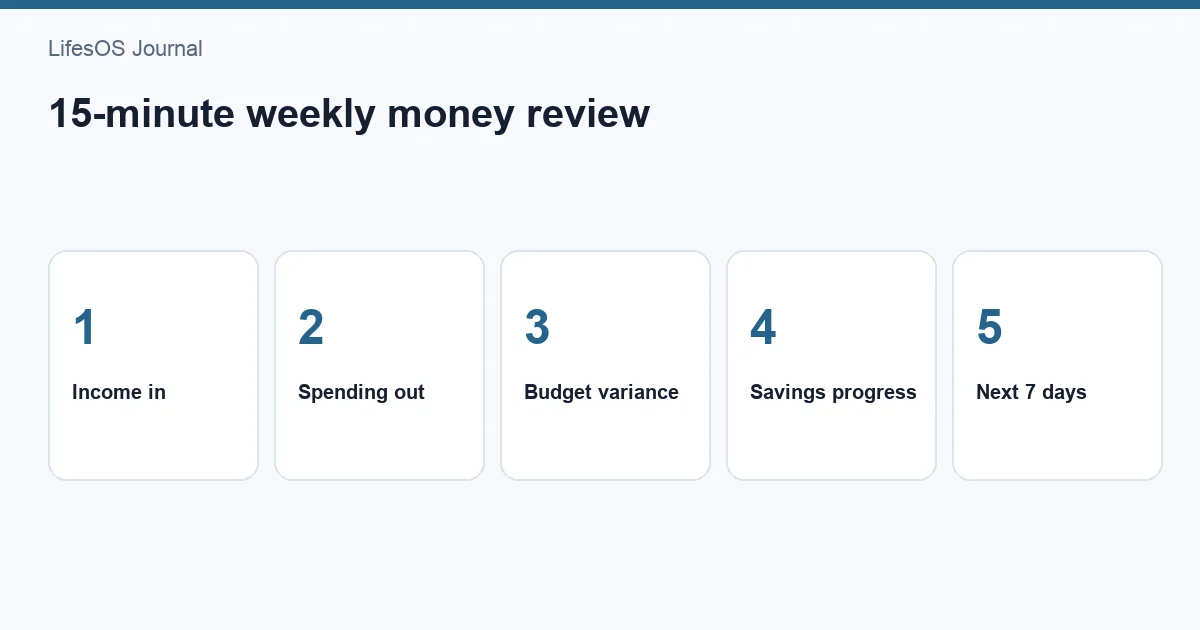
A 15-minute weekly money review that includes one line about sleep ("three nights under six hours") will surface the link faster than any amount of guilt over a single order. The question in the review is not "was that purchase okay" but "which night caused it".
How LifesOS shows the link
LifesOS keeps money, schedule, meals and sleep in one record, so the pattern above becomes a line in your weekly report rather than a hunch. You log in a sentence ("coffee 4 dollars, slept 5 hours") and the AI assistant files it into Finance and Health. After two weeks the report can say which nights cost you money. Start free on the web; the first fifty web sign-ups get half off the first year with code FIRST50.
FAQ
Does being tired really make me spend more, or is it just an excuse?
Both can be true. The valuation shift after sleep loss is measurable in the lab and in real credit data, so the tendency is real. Whether it becomes an actual purchase depends on the environment you build around it.
Is late-night shopping worse than daytime shopping?
Not because of the clock, but because of what the clock correlates with: fatigue, fewer social checks, and apps designed for one-tap purchases. Moving the decision to the morning removes all three.
What about caffeine?
Caffeine restores alertness, not judgement. Studies that measure valuation under sleep loss find the reward bias persists even when people feel awake.
How much sleep is enough to protect my budget?
The data suggest regularity matters as much as hours. Aim for a consistent window first; most adults land between seven and nine hours once the schedule is stable.
Sources
- Venkatraman V. et al., "Sleep deprivation biases the neural mechanisms underlying economic preferences", Journal of Neuroscience, 2011. PMC6622793
- "Sleep restriction and total sleep deprivation alter financial risk preferences", Journal of Sleep Research, 2022 (N = 47). PubMed 35667000
- Self-selected short sleep, sleep variability and risky monetary choice, Journal of Sleep Research, 2022. PubMed 34846092
- "Sleep Disruptions and Information Processing in Financial Markets", Management Science, 2024. INFORMS
- "Insufficient Sleep and Intra-Day Financial Decision-Making", SSRN working paper, 2023. SSRN 4535348
- Hagger M. S. et al., "A multilab preregistered replication of the ego-depletion effect", Perspectives on Psychological Science, 2016.